The Hand We Were Dealt, Artist Statement
Updated: 6 days ago
(Painting After Knowing Series)
Content note: This work engages with Australian colonial history and includes references to colonisation, dispossession and violence against Aboriginal peoples.
Artist Statement
The histories we inherit are shaped not only by what we are told, but by the images through which we first learn to see them.

The Hand We Were Dealt reworks the 1954 collectable swap card 9. Cook at Botany Bay, one of countless popular representations through which colonial history was made familiar, heroic and easily consumed. Produced for children, the card reduced a complex encounter to a small, collectable image capable of passing almost innocently from one generation to another.
The original depicts Cook extending his hand in a familiar gesture of restraint, appearing to calm a marine whose musket is raised towards two Indigenous men. In the work, those men have been deliberately removed. What remains is an oddly suspended scene: the raised weapon, the British Red Ensign, Cook’s outstretched hand and a group of figures apparently caught mid-action.
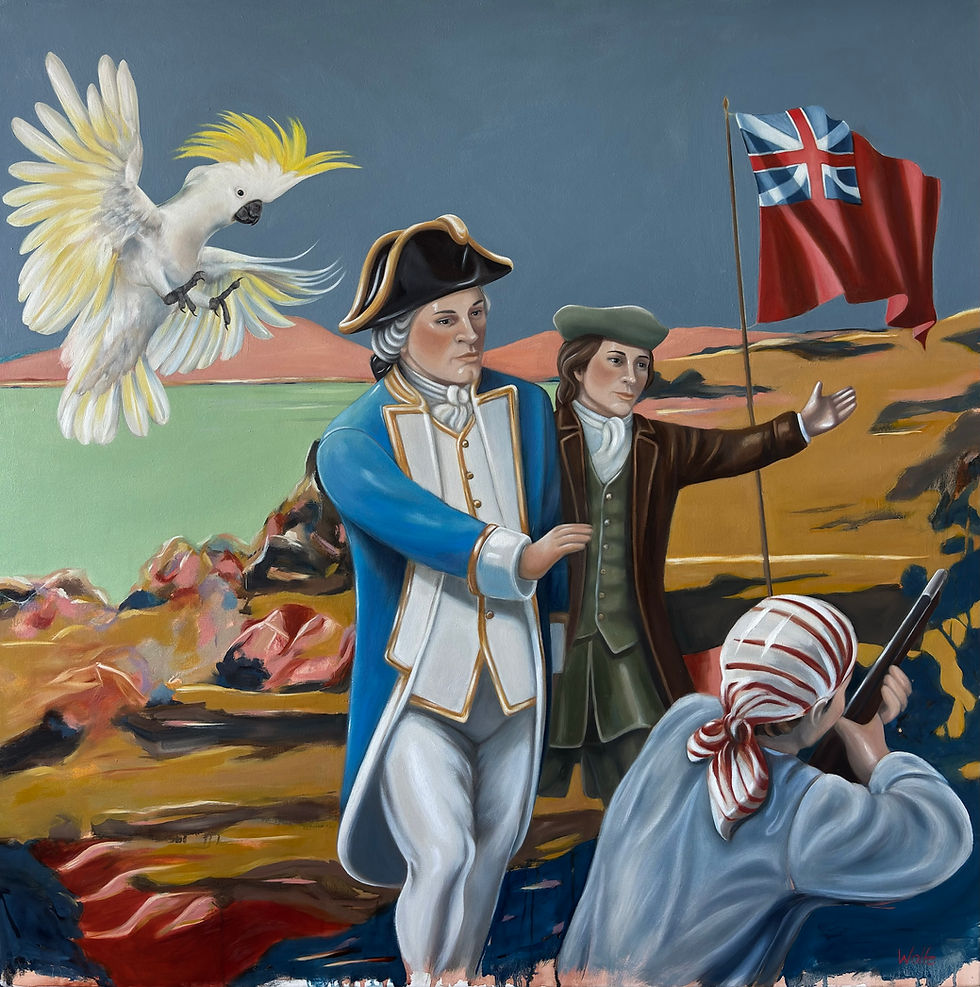
Cook and his crew have become moulded plastic toys, an action figure version of history. Polished, simplified and static, they turn a serious historical encounter into something strange and unreal. Like the swap card itself, they reflect the way historical figures can be reduced to recognisable cultural forms through paintings, textbooks, souvenirs, collectables and national narratives.
The background landscape has also lost its historical certainty. Colonial scenery is recoloured through peculiar pastel hues: artificial, suburban and recognisably Australian, yet entirely unnatural. The Australian sublime becomes strangely decorative. Against it, the frozen figures resemble a tableau vivant in which everything suggests action while nothing can actually move.
Above them, an aghast sulphur-crested cockatoo breaks that stillness. A recurring trope throughout the series, the bird acts as a witness, symbolising the meeting of living knowledge with inherited knowledge. Alert, animated and conspicuously alive against the plastic unreality below , it watches while the colonial figures remain fixed within their inherited poses, none acknowledging its presence.
The painting is less concerned with reconstructing what happened at Kamay than with examining how Australian colonial history has been remembered, displayed and inherited: what we were shown, what we were taught to see, and what becomes visible when we look again.
Rachel Wolfe
9 September 2026
Rachel Wolfe is an emerging artist based in Hobart, Tasmania, currently pursuing a Bachelor of Fine Arts at the University of Tasmania. With a diverse and evolving practice, Rachel explores various mediums and techniques to create captivating and thought-provoking works of art. To explore Rachel's latest projects and artistic journey, visit her website www.rachelwolfe.com.au or follow her on social media.


