A Peculiar Demonstration, Artist Statement
Updated: 6 days ago
(Painting After Knowing Series)
Content note: This work engages with Australian colonial history and includes references to colonisation, dispossession, violence against Aboriginal people and historical nudity.
Artist Statement
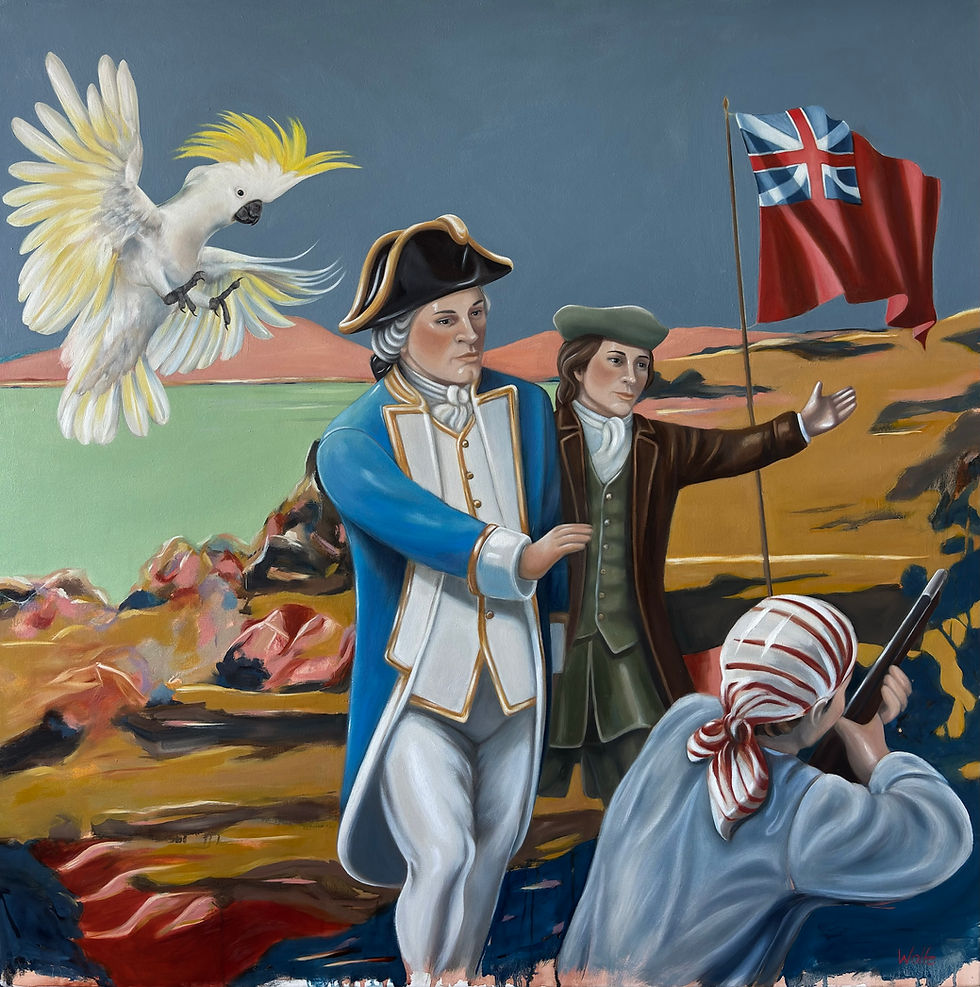
A Peculiar Demonstration begins with a little-known episode from the early encounters between British colonisers and Aboriginal people in Australia. Believing Indigenous people might perceive the newcomers as supernatural beings, Governor Arthur Phillip ordered a sailor to expose himself, demonstrating that they were not gods, but men.

The work was prompted in part by Geoffrey Robertson KC’s observation that, despite the extraordinary nature of the episode, no artist appeared to have depicted it. His observation became a kind of challenge: what might this strange and contradictory moment look like if it were brought back into view?
Viewed in isolation, the gesture appears to assert a shared humanity: we are men, just like you. But knowing what followed reveals a baffling contradiction. The demonstration of a shared humanity sits uneasily beside the dispossession, violence and the assertion of British sovereignty that followed.
The incident contains its own peculiar humour, and the painting allows that absurdity to remain. Phillip and his men are rendered as simplified decorative figurines, polished, static and seemingly benign, while the sailor stands among them with his trousers lowered. The unseriousness of the image is applied to profoundly serious history. What initially appears comic becomes uncomfortable once the purpose of the gesture, and the history that followed, are known.
Behind them, an enlarged fragment of colonial painting has been recoloured and partially dissolved into an improbable pastel landscape. Its unnatural, almost suburban Australian colours turn the colonial sublime into something strangely decorative. Removed from a recognisable historical location, the figures occupy an ambiguous space that is at once familiar and unreal.
Phillip’s hand remains outstretched while his gaze is directed beyond the frame. Above him, an aghast sulphur-crested cockatoo hovers, vividly alive against the static unreality of the manufactured figures. A recurring trope throughout the series, the bird acts as witness, symbolising the meeting of living knowledge with inherited knowledge. Alert, animated and slightly absurd. It watches the scene, yet Philip and the other colonial figures remain fixed within their own worlds, unaware of its presence.
The painting brings this peculiar episode into view, not simply to retell it, but to consider what happens when knowledge changes seeing. What might first appear absurd or almost comic becomes deeply unsettling once its context and its aftermath are known.
Rachel Wolfe
9 September 2026
References
Robertson, G. (2018) ‘Australia Day: Governor Arthur Phillip was our first great blessing’, The Australian, 27 January.
Rachel Wolfe is an emerging artist based in Hobart, Tasmania, currently pursuing a Bachelor of Fine Arts at the University of Tasmania. With a diverse and evolving practice, Rachel explores various mediums and techniques to create captivating and thought-provoking works of art. To explore Rachel's latest projects and artistic journey, visit her website www.rachelwolfe.com.au or follow her on social media.